
October 8, 2026 · Haulalytics Team
How to Get Your Own Trucking Authority in 2026: Steps, Costs, Insurance and Documents
A step-by-step checklist for moving from leased-on to your own operating authority in 2026 — FMCSA filings, what insurance really costs a new authority, the documents to prepare, and how to rent a trailer.
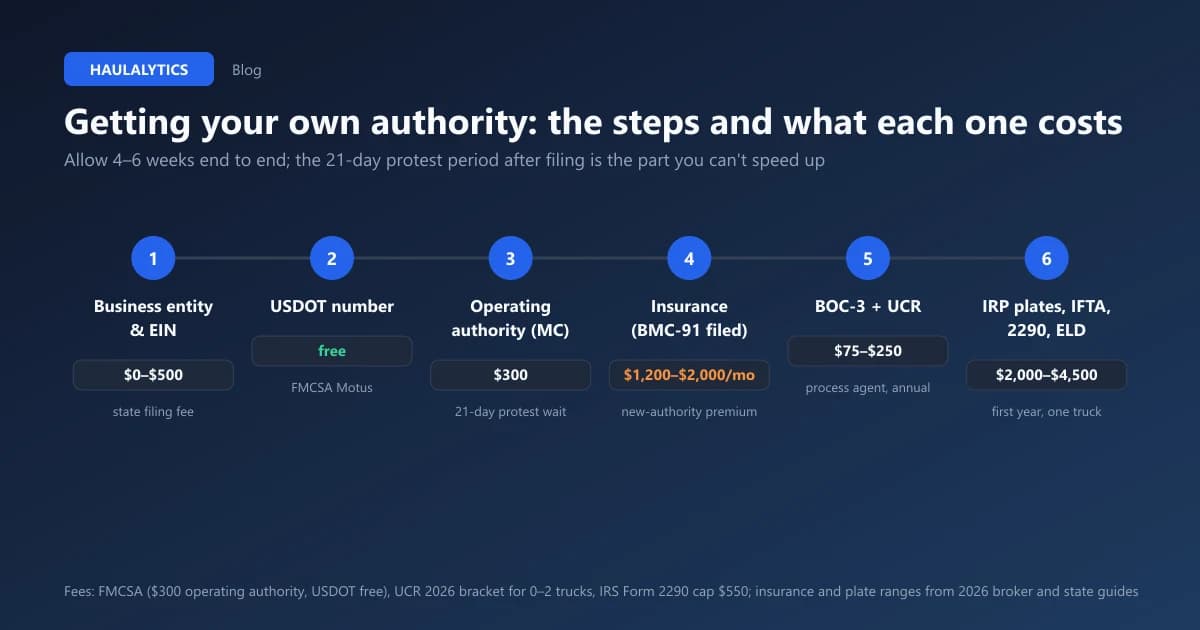
Short answer: Getting your own operating authority in 2026 costs a few hundred dollars in government fees — a USDOT number is free, operating authority is $300, a BOC-3 process agent is $25–$75, and UCR is under $200 for one or two trucks — and takes four to six weeks, mostly because of a mandatory 21-day protest period after you file. The real expense is insurance: a brand-new authority typically pays $1,200–$2,000 a month for the $1,000,000 liability, cargo and physical-damage package brokers expect, and a rented dry van adds $750–$1,200 a month. Budget $8,000–$17,000 to get from leased-on to your first legal load under your own name.
This guide is written for the operator who already has a truck and a CDL, has been running under someone else's authority, and wants to stop handing over a percentage. It covers the order to do things in, what each step costs in 2026, the documents to have ready, and the trailer question.
Key takeaways
- MC numbers have not been eliminated. FMCSA has proposed moving to USDOT-only identifiers, but as of its April 2026 Federal Register language the change is not in effect and would go through public rulemaking first. You still get an MC number with your operating authority in 2026.
- Everything is filed through FMCSA's Motus registration system with a Login.gov account. Third-party "authority packages" charge $500–$1,000+ to do the same filings.
- Insurance activates your authority. Your insurer files the BMC-91 liability certificate with FMCSA; you cannot file it yourself, and without it (and a BOC-3) the authority never becomes active.
- Plan for an 18-month new-entrant period with a one-time safety audit, and for brokers that pay less to carriers under 90 days old.
- If you run Texas intrastate only, the state liability minimum is $500,000; the moment you cross a state line you are under the federal minimum of $750,000, and most brokers require $1,000,000.
Step 1: Set up the business (1–3 days, $0–$500)
Form an LLC or corporation in your state and get a free EIN from the IRS. The LLC is not legally required — you can hold authority as a sole proprietor — but an LLC separates your home from the business in a lawsuit, and insurers and factoring companies prefer it. State filing fees run $50–$500. Open a business bank account before you file anything with FMCSA; your insurer and factoring company will want it.
Have ready: legal business name, EIN letter, business address (a physical address, not a P.O. box), and the name of the person who will be the official contact.
Step 2: USDOT number (same day, free)
Register in FMCSA's Motus system with a Login.gov account. The USDOT number is issued within about a day and is free. You will answer questions about operation type (for-hire, interstate), cargo (general freight), fleet size and driver count. Answer as the operation will actually run; the MCS-150 update you file every two years uses the same data.
Step 3: Operating authority — the MC number ($300, 21-day wait)
For-hire interstate carriers also need operating authority (the "MC number"). The filing fee is $300 per authority type. Once FMCSA publishes the application, a 21-day protest period starts; nothing you do shortens it. The authority is granted after that period only if steps 4 and 5 are already on file.
Many trucking sites claim FMCSA "retired" MC numbers on October 1, 2025. That is not what happened. FMCSA proposed using the USDOT number as the single identifier, but its April 29, 2026 Federal Register notice states the elimination of MC/FF docket numbers is not part of the current Motus release, and any change would come through a Notice of Proposed Rulemaking first. Keep your MC number on your paperwork and expect brokers to ask for it.
Step 4: Insurance (the expensive part)
Your insurer files proof of liability (form BMC-91 or BMC-91X) and, if you haul regulated cargo, the BMC-34 cargo certificate directly with FMCSA. Here is what a one-truck new authority is paying in 2026, from broker and state guides:
| Coverage | Typical requirement | 2026 cost, new authority | | --- | --- | --- | | Primary liability | $750,000 federal minimum; brokers require $1,000,000 | $9,000–$16,000 / year | | Cargo | $100,000 (most brokers) | $800–$2,000 / year | | Physical damage | Lender requires it; ~3–5% of truck value | $2,500–$5,000 / year | | Trailer interchange (rented trailer) | $20,000–$50,000+ | $500–$1,200 / year | | Total, first year | | $14,000–$25,000, financed as $1,200–$2,000 / month after a down payment |
New authorities pay 20–40% more than carriers with two or three years of history because there is nothing to rate against. Premiums drop at the first renewal if the CSA record stays clean. Three things move the quote the most: your driving record, the truck's value, and the radius of operation. Get quotes from at least three agencies that write new authorities; general commercial agents often cannot.
Have ready: CDL and MVR, truck VIN, year, value and lienholder, trailer VIN if owned, your USDOT number, two years of work history, and a down payment of 15–25% of the annual premium.
Step 5: BOC-3 process agent ($25–$75)
A BOC-3 designates a process agent in every state to receive legal papers on your behalf. It must be filed by a process-agent company (not by you) and is usually done the same day for $25–$75. Without a BOC-3 on file the authority will not activate.
Step 6: UCR, IRP plates, IFTA, 2290 and the Clearinghouse
These are not part of the FMCSA authority application, but the truck is not legal interstate without them.
| Item | What it is | 2026 cost, one truck | | --- | --- | --- | | UCR | Annual Unified Carrier Registration, by fleet size | ~$50–$180 for 0–2 trucks (check ucr.gov) | | IRP apportioned plates | Registration shared across the states you run in | $1,500–$3,500 first year, set by your base state and mileage | | IFTA license and decals | Quarterly fuel tax reporting across states | Free to a few dollars; the quarterly filing is the work | | Form 2290 (HVUT) | Federal heavy vehicle use tax, 55,000 lb and up | $100–$550 per year; $550 at 75,000 lb+, prorated for first use after July | | Drug & Alcohol Clearinghouse | Register as both employer and driver; join a random-testing consortium | Registration free; consortium $100–$300 / year | | ELD | Required unless exempt | $20–$50 / month |
IRP requires a stamped 2290 Schedule 1, a current MCS-150, UCR, and an active IFTA license, so do them in that order. If you already run IFTA under your lease carrier, you will need your own license; the carrier's decals are theirs. Our guide to IFTA reporting covers the quarterly filing.
Step 7: Trailer — rent, lease or buy
If the trailer you pull now belongs to the carrier you are leaving, you need your own before the first load.
- Rent a 53-foot dry van for $750–$1,200 a month (2024–2026 units) or $350–$600 for a ten-year-old trailer from a dealer's rental lot. Short-term, no maintenance liability, no down payment. Most listings on TruckPaper and RentalYard are near major metros and require your own trailer interchange or physical-damage coverage.
- Lease-to-own runs $900–$1,500 a month over 36–60 months and ends with a buyout.
- Buy used: a 2018–2020 dry van sells for $15,000–$25,000; new 53-foot vans are $45,000–$60,000 in 2026.
For the first six months, renting is usually right: you do not know your lanes yet, and a trailer that turns out to be the wrong spec (plate vs sheet-and-post, air-ride, logistics posts) is cheap to swap when rented and expensive when owned. Compare the numbers in leasing vs buying a truck; the logic is the same for trailers.
Step 8: After activation
- New-entrant audit. Within 12 months FMCSA (or your state) will audit your driver qualification file, hours-of-service records, drug-testing program, maintenance records and insurance. Have the files before you get the letter; failing the audit revokes the authority.
- Broker setup packets. Each broker will want your W-9, certificate of insurance naming them as certificate holder, authority letter, and a signed carrier agreement. Keep them as PDFs in one folder.
- Factoring or cash. Brokers pay in 30–45 days. Either keep enough cash to cover six weeks of fuel and payments, or factor at 2–4% of invoice. Fuel at $6.20 a gallon makes the cash question bigger than it was two years ago.
- Rate every load. Under your own authority you keep the whole rate, but you also carry the whole cost. Set a floor per total mile and check each load against it — the Haulalytics calculator prices the fuel, tolls and deadhead for you.
Timeline
| Week | What happens | | --- | --- | | 1 | LLC and EIN; USDOT number; insurance quotes; operating-authority filing ($300) | | 1–2 | Bind insurance; insurer files BMC-91; BOC-3 filed; UCR paid | | 2–4 | 21-day protest period; apply for IRP, IFTA, 2290; register in the Clearinghouse; set up ELD | | 4–6 | Authority active; plates issued; first broker packets; first load |
Is own authority worth it in 2026?
Spot rates are the best in four years — DAT's dry van linehaul (fuel excluded) averaged $2.40 in April 2026 and $2.17–$2.25 in September and early October, up more than 30% year over year — which is exactly when leased-on operators notice the percentage they are giving up. The counterweight is cost: a new-authority insurance bill of $1,500 a month plus a $900 trailer is $0.27 per mile at 9,000 miles, before a single gallon of $6.20 diesel. Our profit-per-mile guide shows the full 2026 cost stack; run it with your own numbers before you file.
FAQ
How much does it cost to get trucking authority in 2026?
Government fees are a few hundred dollars: the USDOT number is free, operating authority is $300, a BOC-3 is $25–$75, and UCR is under $200 for one or two trucks. With insurance ($14,000–$25,000 for a new authority's first year), IRP plates ($1,500–$3,500), the 2290 tax (up to $550) and a trailer, most operators spend $8,000–$17,000 before the first load.
How long does it take to get your own authority?
Four to six weeks. The 21-day protest period after FMCSA publishes the application cannot be shortened; the rest of the time is insurance binding, the BOC-3 filing and state plates.
Did FMCSA eliminate MC numbers?
No. FMCSA has proposed using the USDOT number as the sole identifier, but its April 2026 Federal Register notice says eliminating MC and FF docket numbers is not part of the current Motus registration release, and the change would require public rulemaking first. New for-hire carriers still receive an MC number in 2026.
How much is insurance for a new trucking authority?
A one-truck new authority typically pays $14,000–$25,000 in the first year for $1,000,000 liability, $100,000 cargo and physical damage, financed as roughly $1,200–$2,000 a month after a down payment. Premiums usually fall 20–40% at the first renewal with a clean record.
What documents do I need to get my own authority?
Your LLC filing and EIN, a physical business address, CDL and motor vehicle record, truck VIN, value and lienholder, trailer VIN if owned, proof of insurance filed by the insurer (BMC-91), a BOC-3 filed by a process agent, UCR receipt, stamped Form 2290 Schedule 1, IFTA license, and Clearinghouse registration as both employer and driver.
Can I rent a trailer as a new owner-operator?
Yes. Dealers rent 53-foot dry vans for about $750–$1,200 a month for recent models and $350–$600 for older units, usually with a credit check and proof of trailer interchange or physical-damage coverage. Renting for the first six months avoids buying the wrong spec before you know your lanes.